Chaos Studies on Playdate
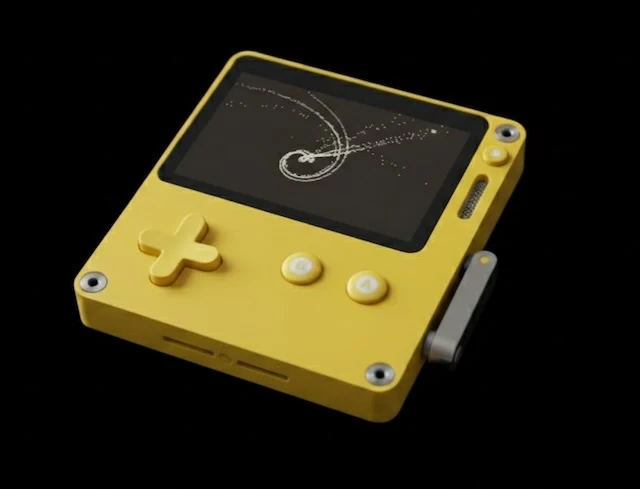
Chaos Studies came first on Panic's Playdate, a handheld with a 1-bit screen and a crank. It draws the same nine strange attractors as thousands of 1-bit points, and you turn them with the crank. It is $2.99 in the Playdate Catalog, bought separately from the iPhone, iPad and Mac version.
Playdate · 400 × 240 · 1-bit
How it started
Tracking thousands of points fast enough on the Playdate needed a custom C module. The constraint decided what mattered: 1-bit points on the Playdate's screen and your hand on the crank.
The iPhone, iPad and Mac version kept that direct control and added colour, depth and the spatial mix. The Playdate version is still sold, in the Playdate Catalog.
Controls
On the menu screen
- Up, down
- choose an attractor
- A
- start the visualisation
- Left, right
- add spin
- B
- open the instructions
In the visualisation
- Crank
- turn around the attractor vertically
- Up, down
- zoom in and out
- Left, right
- add spin
- A
- start it over, with the explosion
- B
- back to the menu
- Tilt
- a slight parallax that adapts to how you hold it
The system menu
Three settings sit in the Playdate system menu. Dark mode inverts the colours. Crank hint shows or hides the crank indicator while the crank is docked. Music picks Calm, Crisp or None.
Music
The Playdate plays two pre-mixed stereo tracks made from the same loops as the Apple version. Calm is tings, pad, drone and cello. Crisp is tings, pad and percussion.
How it differs from the iPhone, iPad and Mac version
Both draw the same nine systems and use tilt for a parallax effect. Both also switch between light and dark: on Playdate, dark mode in the system menu inverts the colours. On Playdate you turn the attractor with the crank and zoom with the d-pad, in 1-bit. The Apple version is turned by dragging, runs on the GPU with 6,000 particles per attractor, and adds colour, depth of field, and the seven-stem spatial mix with its five presets.
Privacy
The Playdate version uses the device's accelerometer for parallax and the crank for rotation. No data leaves the device. The privacy policy covers both versions.