Definition
What a strange attractor is
A strange attractor is the shape a chaotic system settles into. Start a point near it, move the point by a few simple equations, and it never repeats its path and never leaves the shape. Two points that start a hair apart soon end up in unrelated places, yet both trace the same figure.
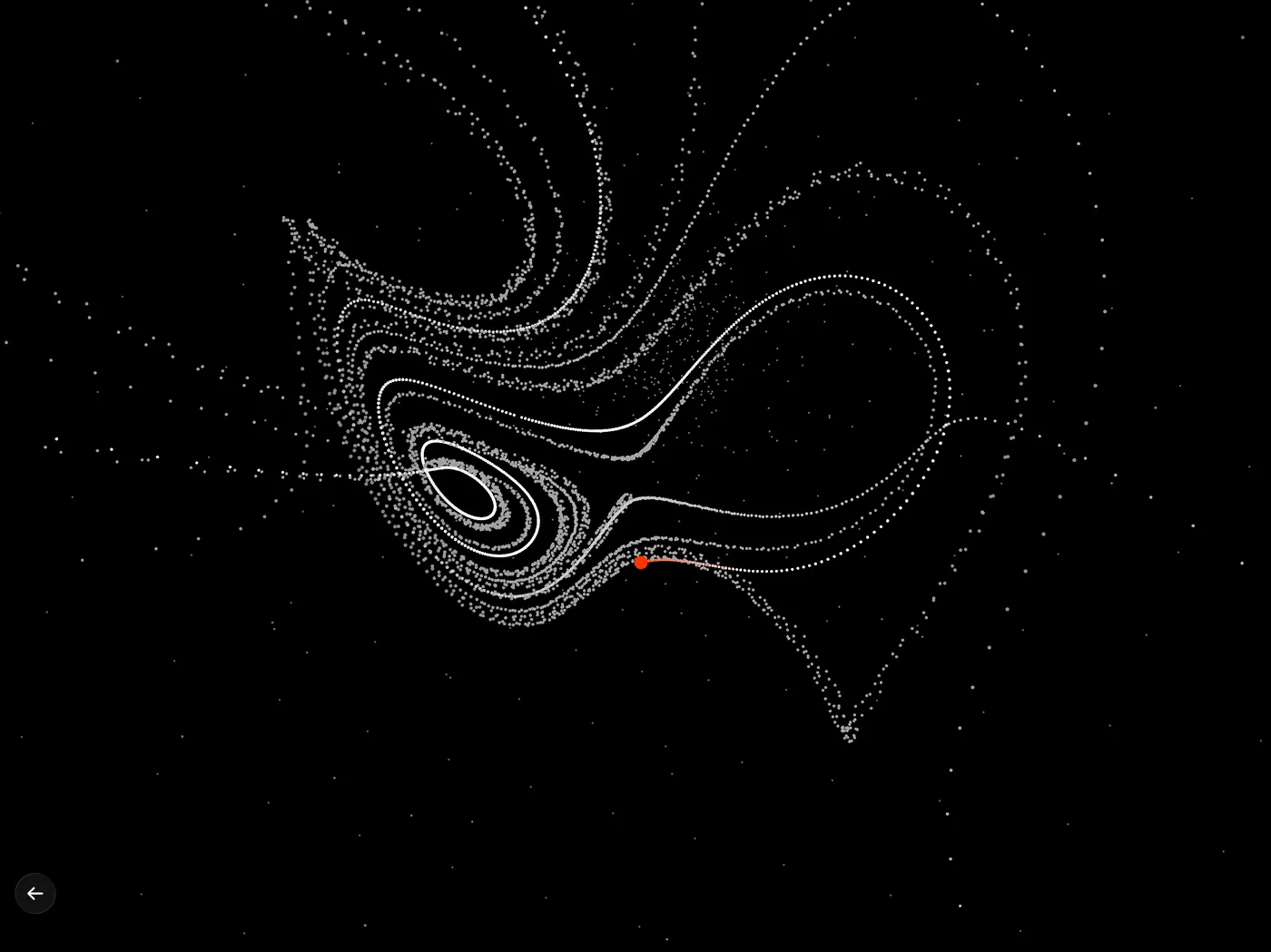
The equations are short. Edward Lorenz's 1963 system, the first and best known, is three lines with three parameters. Chaos Studies draws nine of these systems as clouds of particles. Each new point is laid down red and cools to white as it ages, so the red end of the trail is always where the system is now.
The longer explanation, from fixed points to fractal dimension, is in What is a strange attractor.
The Lorenz system
σ = 10, ρ = 28, β = 8/3. The app steps it forward every 0.007 time units.
Field guide · nine systems
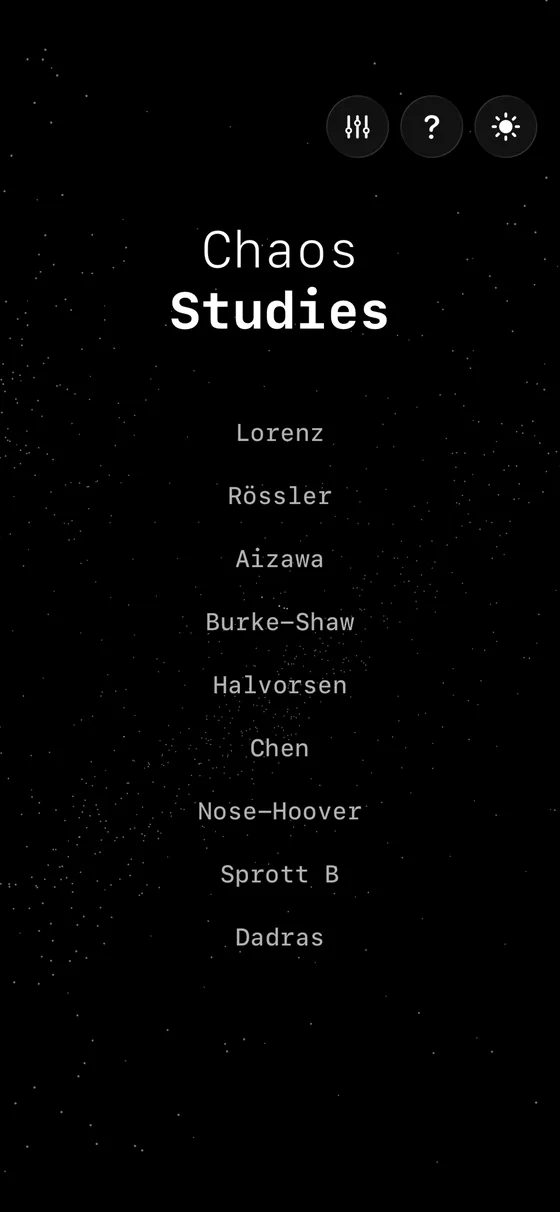
The nine attractors
Each page has the equations, the parameters the app uses, where the system came from, and a live simulation you can turn.
Lorenz
restlessTwo wings around two fixed points. The point circles one, then switches to the other without warning.
Equations and historyRössler
meditativeOne band that spirals out, lifts, folds and drops back in. A single nonlinear term does all of it.
Equations and historyAizawa
coiledA shell like a sphere with a tube through its axis. It only makes sense once you turn it.
Equations and historyBurke-Shaw
compactA relative of Lorenz, wound tight into a small space. Zoom in for the layers.
Equations and historyHalvorsen
architecturalThree identical wings. Swap x for y, y for z and z for x, and the equations stay the same.
Equations and historyChen
turbulentLorenz's cousin, with wider lobes and a busier crossing between them.
Equations and historyNose-Hoover
patientSmooth loops that look orderly for a long time. The app opens on this one.
Equations and historySprott B
energeticFound by a computer search for the simplest chaotic flows. Loose and quick.
Equations and historyDadras
wovenOverlapping sheets that read differently from every angle. Turn it slowly.
Equations and historyiPhone · iPad · Mac
What the app adds
The simulation at the top of this page is a small version of the engine, running in your browser. The app runs all nine attractors on the GPU and adds the parts a web page cannot reach.
- RenderingMetal, 6,000 particles per attractor, with depth of field that softens the points far from the focal plane.
- TiltOn iPhone and iPad the attractor shifts with the device, a parallax that adapts to how you hold it.
- SoundThe full seven-stem spatial mix, five presets, and a synth that follows the particle being drawn.
- MeditativeA slower drawing speed, for leaving it running.
- ScatterTap and the points implode, explode and find the shape again.
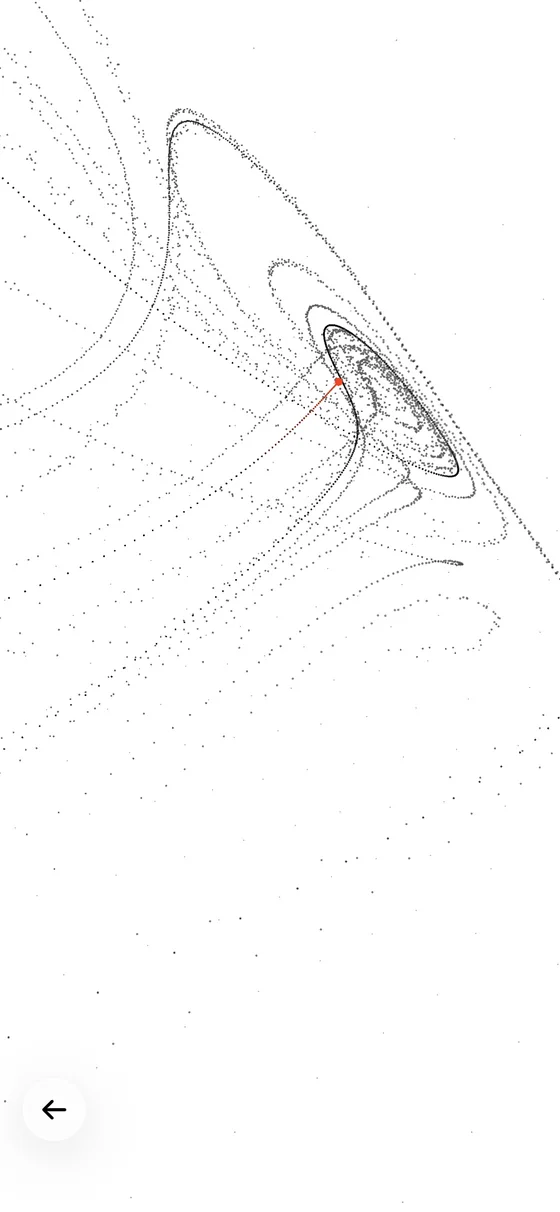
- ModesDark, and a white mode that draws the attractors like ink on paper.
No score, no goal, no account, no tracking. It works offline.
Spatial soundtrack
Seven stems, placed around you
The soundtrack is seven loops composed on the teenage engineering OP-XY. Each one sits at a point around you: tings above, pad below, percussion in front, cello behind, drone to the left, bass to the right, kick in the middle. When you turn the attractor, the stems turn with it. On headphones you can hear the cello come round from behind.
A small synth follows the particle being drawn. Its pitch rises with the particle's speed, so fast passages through the attractor sound different from the slow ones.
| Calm | tings, pad, drone, cello |
|---|---|
| Crisp | tings, pad, percussion |
| Cine | tings, cello |
| Driven | all seven |
| None | silence |
Playdate · 400 × 240 · 1-bit
It started on a Playdate
The first Chaos Studies ran on Panic's Playdate, a handheld with a 1-bit screen and a crank. Tracking thousands of points fast enough needed a custom C module. The constraint decided what mattered: 1-bit points on the Playdate's screen and your hand on the crank.
The iPhone, iPad and Mac version kept that direct control and added colour, depth and the spatial mix. The Playdate version is still sold, in the Playdate Catalog. Its full controls and music are on the Playdate page.
- Crank
- turn the attractor
- Up, down
- zoom
- Left, right
- add spin
- A
- start it over
- Music
- Calm, Crisp or none
 $2.99 in the Playdate Catalog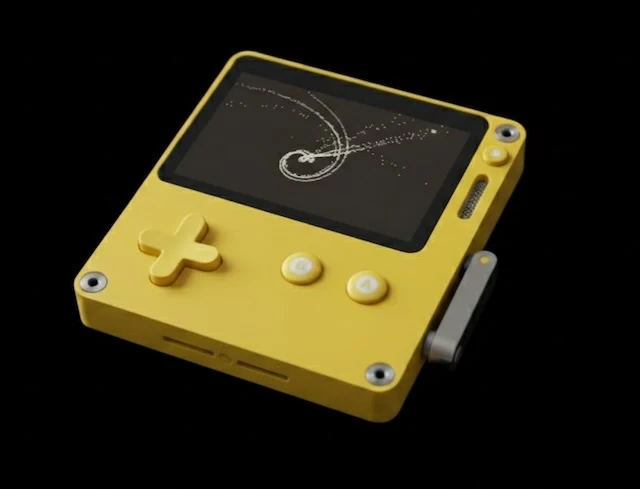
Get it
Two versions, bought separately
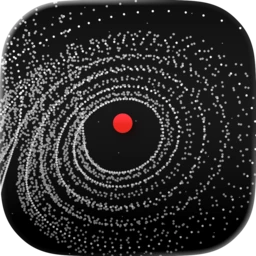
One App Store purchase covers iPhone, iPad and Mac. No subscription, no in-app purchases, no account.
In Panic's Playdate Catalog. The 1-bit original, played with the crank, with the Calm and Crisp music.
Questions
Questions people ask
- What is Chaos Studies?
- An app that draws nine strange attractors in 3D as clouds of particles, with a soundtrack placed in space around them. You turn, zoom and scatter the attractors by hand. It is the first piece in the ET Series by Field Bureau + Werkstatt.
- Is it a game?
- No. There is no score and no goal. It is closer to an instrument or a moving drawing. You can open it for a minute or leave it running for ten.
- Do I need headphones?
- No, but they help. The stems are panned by where they sit around you, so on headphones you hear the mix turn as you rotate the attractor. On speakers you get the music with less of the movement.
- Which devices does it run on?
- iPhone, iPad and Mac from one App Store purchase, and Playdate through Panic's Playdate Catalog, bought separately.
- Can I use it to teach chaos theory?
- It shows what the equations do, which a textbook figure cannot. The field guide on this site gives each system's equations and the parameters the app uses, and the Lorenz page shows sensitive dependence live. The app itself has no lessons or quizzes.
- How much does it cost?
- $1.99 once on the App Store for iPhone, iPad and Mac, and $2.99 on Playdate. No subscription, no in-app purchases, no account.
- How is the Playdate version different?
- It came first. It draws in 1-bit on the Playdate's screen, you turn the attractor with the crank, and it has the Calm and Crisp music. The Apple version adds colour, depth of field, the seven-stem spatial mix and its five presets.